Universities
No battery survives an eight-hour day on campus
Students arrive in the morning and leave at night. Everything in between runs through the phone.
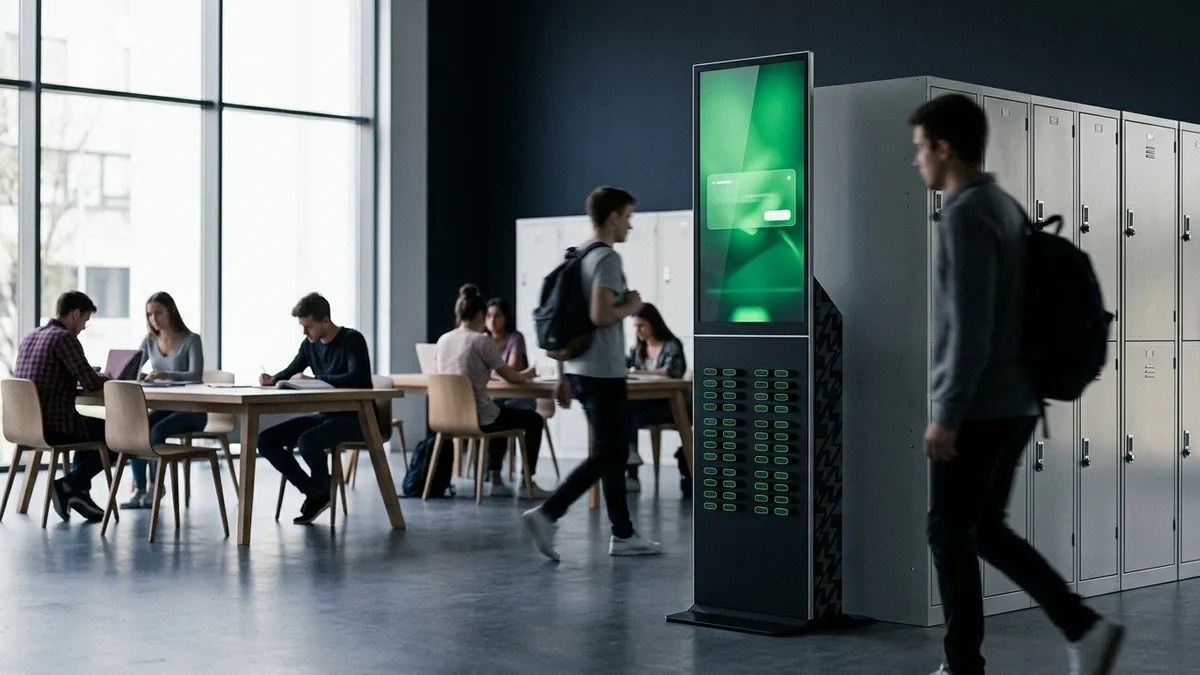
On a university campus the day is long and the phone is central: notes, the virtual campus, admin, course group chats and the journey home. A Chargo station in a hall or study area lets students carry the charge between lecture rooms instead of competing for a socket in the library.
Key takeaways
- A university day is long and no phone covers it on a single charge.
- Notes, the virtual campus and admin all depend on the handset.
- Library sockets are scarce and turn seating into a competition.
- Portable charge moves between rooms, which is how students actually move.
- Study areas and halls are where demand concentrates.
The problem
Eight- or ten-hour days with the phone as a core tool and very few sockets to go round.
A station in a hall or study area provides portable charge that moves between rooms with the student.
Benefits
What changes in your business
No more fighting for a socket
Students stop picking a seat by where the outlet is rather than where they'd actually study best.
The charge follows the timetable
Students change rooms several times a day; the battery goes with them.
It holds up the virtual campus
If attendance, materials or admin are digital, a dead phone blocks the day.
A service students can see
It's a concrete improvement to campus life, not an institutional promise.
Use cases
- Study areas and libraries where sockets are scarce.
- Halls and student union spaces with heavy movement between classes.
- Exam periods, when days run longer than usual.
- Open days, conferences and public events held on campus.
Why a campus is such a clear case
The combination is hard to find anywhere else: very long stays, intensive phone use, and electrical infrastructure designed for lecture rooms rather than hundreds of personal devices.
You can see the result in any university library — the seats near a socket fill first and the rest stay empty, even when they're better places to work.
Students move; sockets don't
A day of classes means changing rooms, floors and sometimes buildings. A charger fixed to a wall doesn't help with that — it forces you to leave the phone somewhere and come back for it.
A battery inverts the relationship: the battery follows the student between rooms.
Predictable peaks
Exam periods, open days and public events concentrate far more demand than an ordinary week. They're worth accounting for when sizing.
Frequently asked questions
Where should it go on a campus?
In study areas, libraries and halls with movement between classes — the points where students actually stop.
Does it help during exam periods?
That's when it shows most: days run longer and charging demand rises above a normal week.
Do I need one per building?
It depends on size and how students move around. With a campus map we can work out how many and where.
Bring Chargo to campus
Tell us how many students come through and how the buildings are laid out.